LinkPost
Create viral LinkedIn content, scientifically
LinkedIn Algorithm Playbook 2026
We analyzed 428,659 LinkedIn posts to understand what still works in 2026, and why some multiply their reach x10 while yours collapses.
0
posts analyzed
0
comments analyzed
0
sentiments analyzed
↓ Scroll to understand why
19 sections, based on 428,659 LinkedIn posts analyzed. You'll discover everything the "experts" hid from you because they didn't know themselves.
Where our numbers come from
428kThe 2026 reach collapse
−18%The secret to crafting a viral post
Big Idea × Authority
most importantPackaging: hook + visual
Tactics & rules (33 criteria)
The 66% rule
Format #1: the polarizing post
×1,82Format #2: the lead magnet post
0Format #3: the celebration post
×1,5Format #4: news hacking
×2-3Fatigue × pattern interrupt
The AI era: info ↓, singularity ↑
The formats AI killed
The 4 myths to bury
The magic timing
×4,7Triple your reach in 15 min/day
+29%The 13-point anti-flop checklist
Take action
Part 1
0
LinkedIn posts analyzed
Collected, enriched and continuously re-scored since 2025.
33
tactics and rules measured
22 attention tactics + 11 virality rules, detected in every post.
See the full docs →0
comments analyzed
Sentiment, controversy and emotions extracted from every discussion.
Key takeaway

Not a Claude wrapper.
12 months of R&D, 1M posts analyzed and 33 objective criteria measured on our own dataset. You generate your posts with Claude and cap at 200 views. Our algo knows why.
Source: data from LinkPost, the largest database of analyzed LinkedIn posts.
Part 2
Last 6 months · 389,565 posts compared · all niches
Text
0,0%
average likes vs 2025
Image
0,0%
average likes vs 2025
Carousel
0,0%
average likes vs 2025
Video
+0,0%
average likes vs 2025
We spent 12 months building an algorithm that predicts what explodes on LinkedIn. We doubted a lot, tested a lot. In this playbook, I share everything in detail, no filter.
2 minutes ago
The algo wrecked me. I don't get it anymore.
The proof
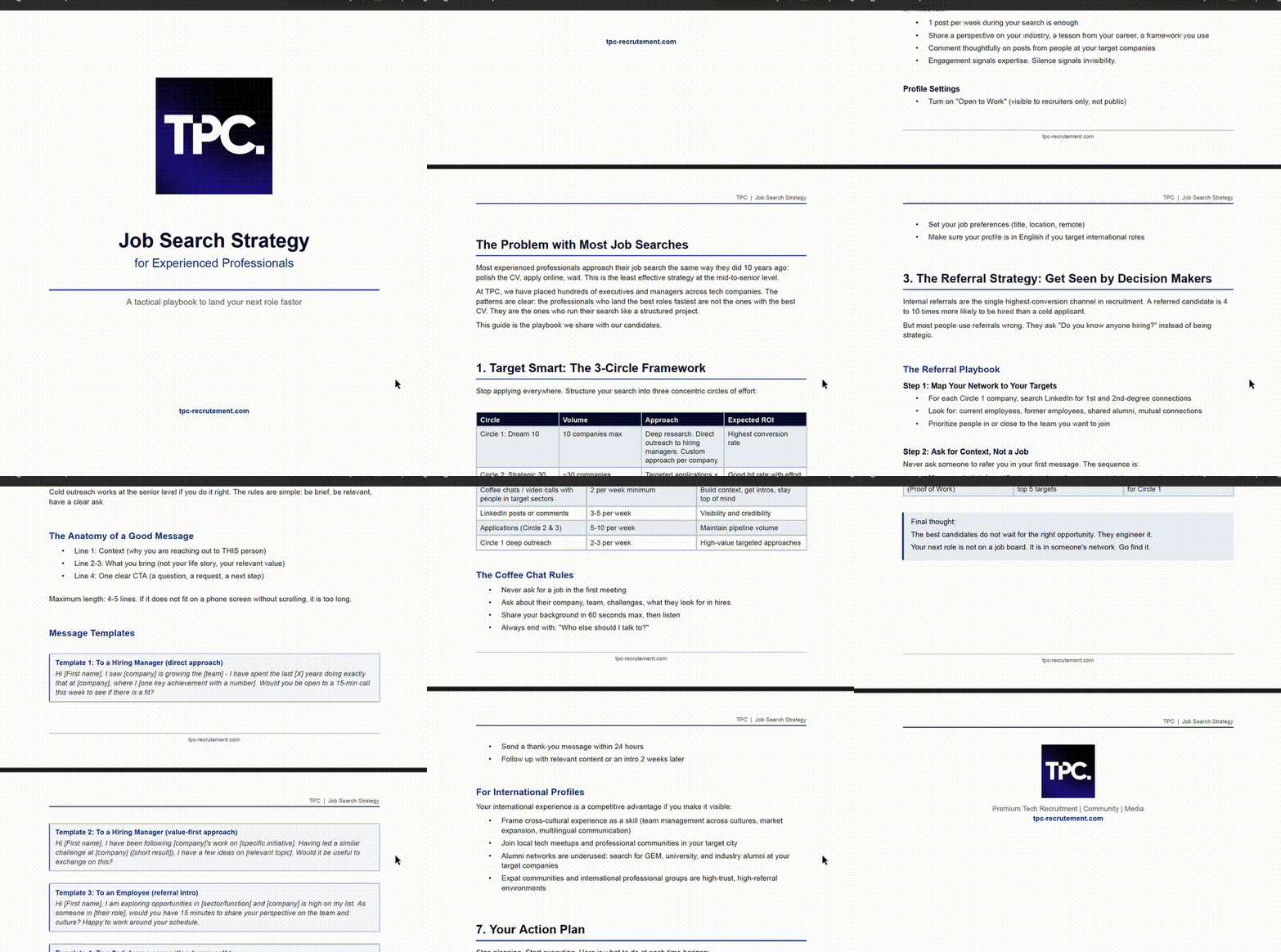
Real LinkedIn posts that exploded in 2026. Same feed, same audience, same algorithm — except they played by the rules below.


Access more than a million analyzed posts with the X-Ray mode
See more LinkedIn inspirationsPart 3
A viral post = 3 ingredients. Not just any three.
And definitely not in any order.
The most important
Big Idea × Authority
A surprising idea, carried by someone for whom it's credible. That's that fusion triggers emotion and what makes your post stand out. Without without one, the other falls flat.
The packaging
The packaging of your post. The hook (what shows before “see more” on LinkedIn) and the visual. That's what decides if we keep reading.
The body
Everything that comes after the "see more". Only work on it once the 2 previous layers are mastered. Then we'll apply the 33 rules and tactics + the 66% rule.
Key takeaway
Who you are + the idea: 10× more important than your packaging.
Your packaging: 10× more important than your post.
And your post? A distant last.
Big Idea × Authority
A surprising idea, said by someone for whom it's credible. That fusion is what triggers emotion and makes your post stand out from the feed.
Big Idea
Your angle on the topic
The central message of your post, in 1 sentence. A strong, memorable opinion that takes a stance. Not a lukewarm observation. Not a generality.
Authority
Why people listen to you
What proves you know what you're talking about on this specific topic: your experience, your years in the field, your results, what you built.
The formula in practice
Each of these posts crossed 6,500 likes. Not by chance: a sharp angle, said by someone for whom it's literally their job.
Big Idea
It is unacceptable that she died at 44 of a cardiovascular disease that could have been prevented.
Big Idea
Just because it isn't your culture doesn't mean it's the culture of emptiness.
Big Idea
It's not entrepreneurs who are bleeding France dry. It's your systems strangling them.
The packaging
The hook and the visual. Nothing else. So invest 99% of your time there, and don't write a single line of content before.
Hook+Visual=Packaging
The reflex
Packaging d'abord.Content comes after.
The packaging · Hook
The hook determines if people will keep reading.
Hook length is not a decisive factor. Observed median: 66 characters.
What matters: the pattern, not the character count.
The packaging · Hook
"R.I.P. [established thing]" / "[X] is dead"
0
avg comments
"Claude Cowork is killing manual prospecting."
"A 3,000€/month SDR agency? It's over."
"Claude + Veo3 is the end of 5,000€/month video agencies."
"I created [X product/tool]"
0
avg comments
"I built a tool that lets you generate AI agents from a single sentence."
"I built a GEO analyzer"
"I turned Claude COWORK into a 24/7 LinkedIn prospecting SDR!"
"I'm giving you [free resource]"
0
avg comments
"🎁 The future of sport: major trends through 2035, free study!"
"I'm giving you the ultimate Claude guide (2026 Edition)."
"I'm giving you, for free, a Figma template that saves me 4–6 hours on every project."
The body
Boost your dwell time using the 33 rules we discovered while building our virality prediction algo.
The metric LinkedIn actually watches
Dwell time
The time someone spends looking at your post before scrolling. It's the signal the algo uses to decide whether to push or kill your post. Every extra second = multiplied reach.
Step 1
Capture attention
Interrupt the scroll on the very first line.
Step 2
Hold attention
Pull the reader line after line, all the way to the punchline.
Step 3
Hit emotionally
Make your post personal, provoke a reaction.
Step 4
Convince & convert
Establish proof, trigger the click.
The Codex
Result : 33 rules that explain everything — the codex.
The hook is the first line of the post. It must be clear, emotional or surprising — enough to make people read on.
A question, mystery or unfinished story opened at the start, resolved only at the end. The brain hates loose ends.
A small loop opened mid-post (a hint, a tease, a half-answer) that holds attention to the next paragraph.
A line, format or image that clashes with what people are used to seeing in their feed. The brain stops to process the anomaly.
You hint at the outcome without giving it. The reader keeps scrolling through the post just to close the loop in their head.
The first line takes the opposite stance to a widespread belief. The reader has to keep reading to find out if you can defend it.
A series of short, parallel lines (often verbs or facts) that build momentum and pull the eye line by line.
Sentences get shorter (or sharper) as the post progresses, like steps leading to the punchline. Pacing carries the reader.
Sparse Unicode symbols (→, •, ✓, …) that visually segment the post and guide the eye through the structure.
Alternate short and long lines, blank lines, occasional bold — anything that breaks visual monotony.
A direct question to the reader that invites a comment. Works best when it touches an opinion, not a fact.
A position strong enough that nobody can stay neutral. People comment to defend or attack — both feed the algo.
One sentence punchy enough to live on its own — quotable, repostable, the kind people highlight.
A take only your specific experience could produce. Not advice — the raw insight you pulled from what you lived.
You promise a free resource. The reader has to comment a specific word ("YES", "DM me"…) to receive it. Massive comment driver.
A small visual irregularity (typo, weird spacing, broken capitalization) that breaks the scan rhythm and grabs attention.
Anaphora, parallel sentence openings, or a repeated phrase that creates an emotional cadence the reader can feel.
Honest exposure of a struggle, mistake or fear. Creates instant emotional bond — most people won't dare write it.
Move the reader from joy → sadness, success → failure, certainty → doubt. The emotional jolt makes the post unforgettable.
You stage the gap between an old and a new version of yourself, your business or your worldview. The reader projects.
Specific numbers (€, %, dates, sample size) that make the post credible and screenshot-worthy.
Names, testimonials, customer count, media coverage — anything that proves you're not the only one believing this.
Cramming three messages into one post divides their impact by three. Pick the strongest one and cut the rest.
Plain words, short sentences, one idea per line. The reader's brain shouldn't have to work to decode you.
Spacing, line breaks, lists, bold — design choices that turn a wall of text into a scannable post.
The post follows a clear thread: cause → effect → consequence → conclusion. No jumps, no missing links.
80% of LinkedIn happens on mobile. Apply the 66% rule: control your line breaks so nothing reads awkwardly on a phone.
You aim for a clear emotion: surprise, anger, pride, hope. An emotional post outperforms a purely informational one every time.
You build tension between two poles (hope/fear, pride/doubt) and hold it across the post. The reader can't look away.
A personal scene, a precise moment, a real character. Lived experience beats theory every time on LinkedIn.
The post stages a clear shift (mindset, results, identity) that feels reachable. The reader projects themselves into the after.
Open question, polarizing call, fill-in-the-blank — anything that gives the reader a clear reason to take action.
Numbers, real cases, specific anecdotes. Proof beats adjectives. "15 years in B2B SaaS" > "I'm an expert".
A name, a place, a time, a specific number — anything that turns an abstract claim into a real scene.
Discover the 33 tactics and rules the pros stack to max out their dwell time.
See the full codexThe body
LinkedIn cuts your sentences differently on desktop, tablet and mobile. Without manual line breaks, it decides where to cut. And it decides badly.
Classic format
Yannis Haismann
LinkPost founder · 5d
I hadn't planned to make this post, and honestly, nobody will read it. All the better, it's personal.
Being an entrepreneur means being fundamentally unsatisfied: unsatisfied with the French state, unsatisfied with monthly revenue, and unsatisfied with progress over time.
Yet today, I'm grateful. Not for the revenue generated, not for the number in my account, not even for my LinkedIn follower count — but simply because I get to work with people I respect and admire.
LinkedIn format
Yannis Haismann
LinkPost founder · 5d
I hadn't planned to make this post.
Nobody's going to read it. All the better, it's personal.
Being an entrepreneur means being unsatisfied.
Unsatisfied with the French state.
Unsatisfied with monthly revenue.
Unsatisfied with progress over time.
Yet today I'm grateful.
Not for the revenue generated.
Not for the number in my account.
Not for my LinkedIn follower count.
But because I get to work
with people I respect and admire.
On the right, the author crafted their post to stay readable on all screens.
On the left, they let LinkedIn handle it. And since 80% of your audience is on mobile,
that's where it all plays out.
Format #1
x0,00
in likes vs. a consensus post.
And ×1.23 on comments along the way. Measured on 113 386 LinkedIn posts analyzed.
Structure
"Everyone thinks X. It's false."
"Here's Y. And here's what my experience proves."
Format #1
Sentiment, emotion, controversy. The largest French-language LinkedIn dataset: 153,508 posts, 12,020 authors. The verdict is unforgiving.
Verdict: nice posts get scrolled. Polarizing posts get reactions. And the algo only pushes reactions.
Format #1
152,182 LinkedIn posts analyzed. For each post, we identified the dominant emotion expressed in its comments, then calculated its average likes.
Result: provoking beats pleasing by +50%.
Format #2
There are dozens of strategies on LinkedIn. But the current meta — the one generating the most visibility and clients with the least effort — is the lead magnet: a resource offered in exchange for a comment.
Source: data from LinkPost — the largest database of analyzed LinkedIn posts.
Format #2
Ranking of the 14 types by average comments.
Format #2
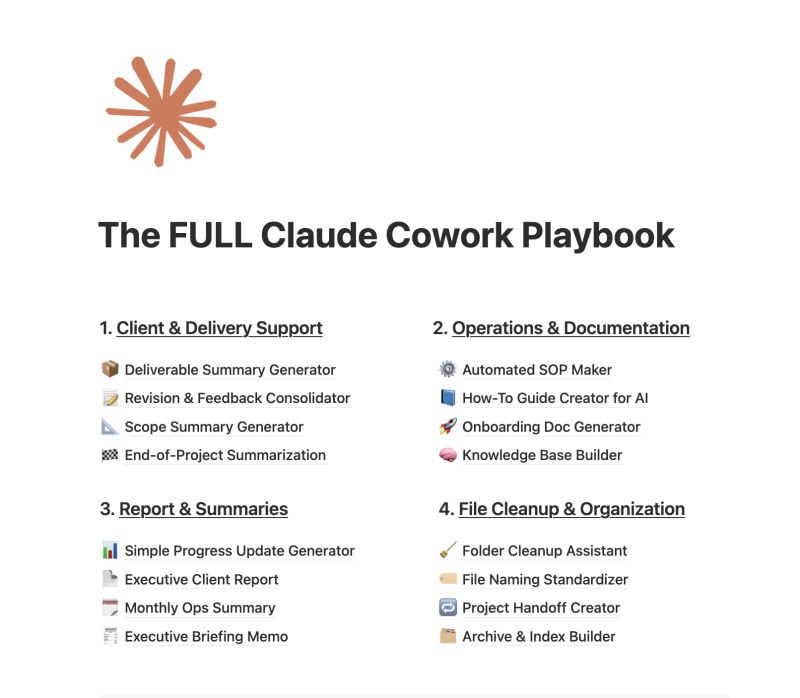
Real lead magnet posts for each type. Click to see the original post.
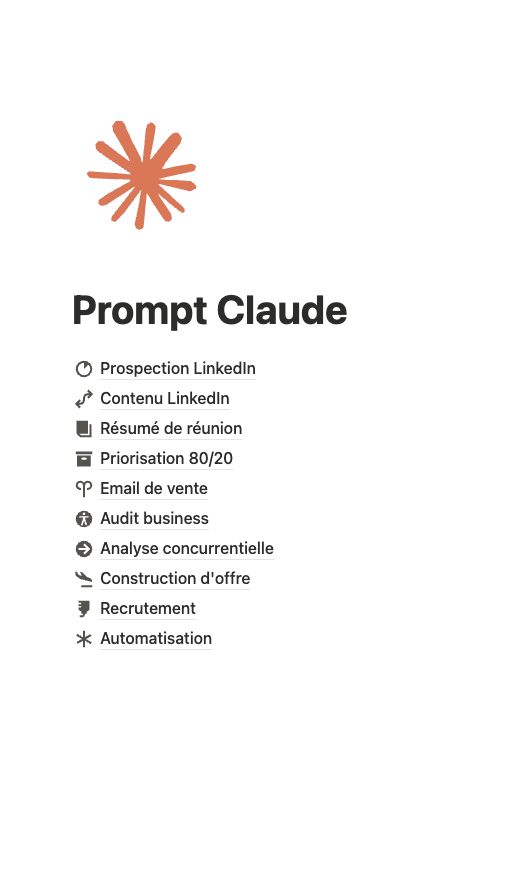
Prompt Pack
Format #2
Key principle
Never create the resource first.
Packaging (= your hook + your visual) is what is what makes people stop and comment. The resource is built after — custom, to match the post.
Phase 1 — The packaging (hook + visual)
Get inspired by what works
Browse the viral lead magnets in your niche. Spot the hooks, visuals and angles that perform.
Create the hook + visual
It's that combo that decides whether your post will be viral or ignored. Everything else depends on it.
Phase 2 — The content
Write the post
Structure around the hook. 70% value + 3-step CTA.
Build the resource to fit
Only now. PDF, video, course, tool — whatever the format, it must match the post.
Publish, engage and follow up
Tuesday 12pm-1pm. Reply within the 1st hour. Send the resource automatically by DM.
Format #2
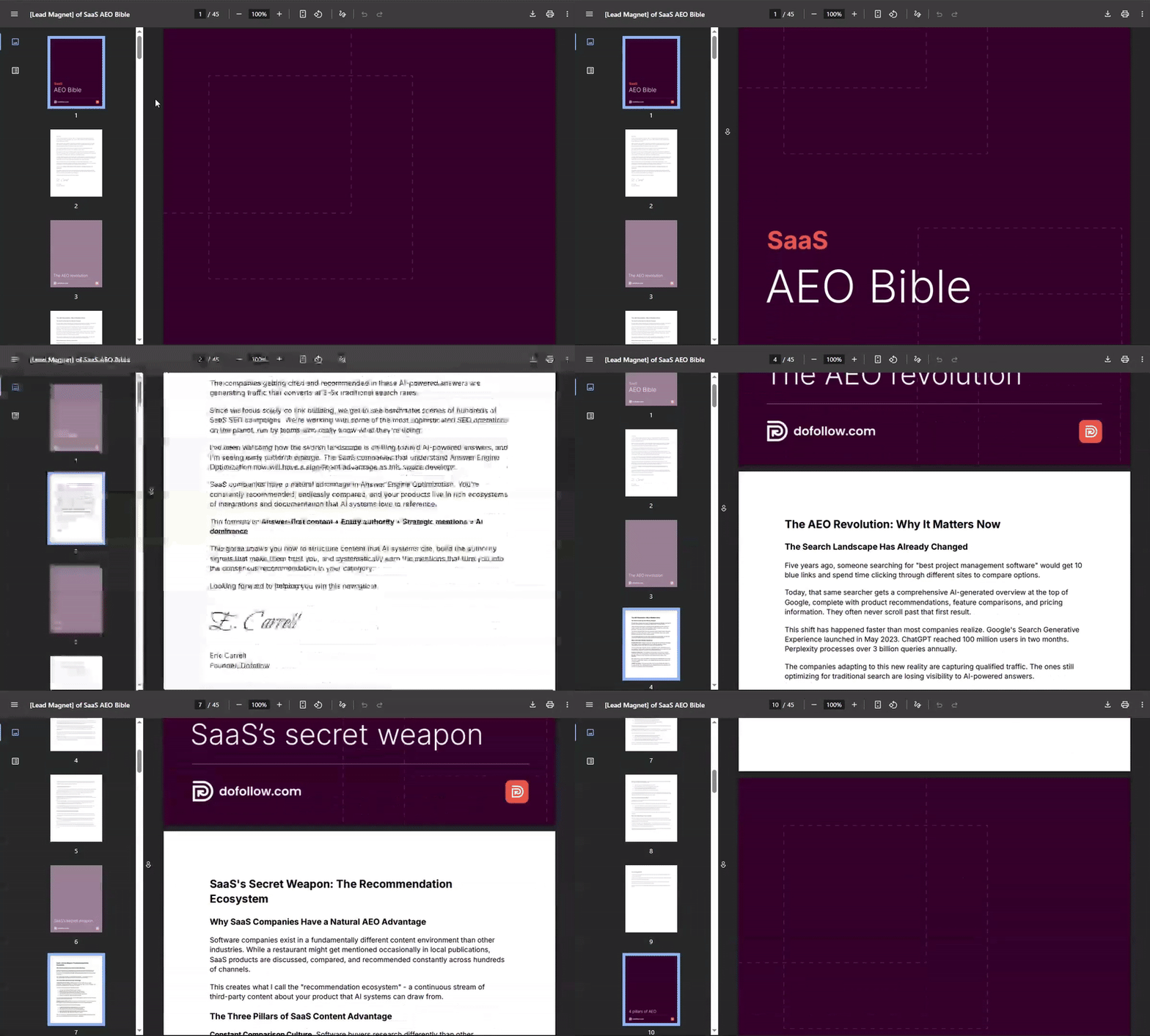
These 4 slides are just a preview. The LinkMagnet playbook delivers our full strategy to generate hundreds of clients with lead magnets.
Lead magnets vs standard posts
SeenThe 14 resource types ranked
SeenThe hook formula with 797 comments
The CTA structure that triples results
×3.2The forbidden technique
Automate resource delivery
Format, media and real examples
SeenAI's impact on engagement
The perfect time to post
The tactical recipe
5 copy-paste-ready templates
15-point pre-publish checklist
The complete 5-step method
SeenRotating across 15 lead magnets
The fatal mistakes to avoid
Format #3
MRR, hiring, user milestones, new resources: turn every traction signal into a post that crushes it.
What's your momentum?
People are naturally supportive. Celebrate, and they celebrate with you = easy likes, exploding reach.
Format #4
Be the first to react to a news topic in your niche.
×2-3
in reach when you post within 24h
The game rule
Human behavior
Your audience scrolls to feel. Anything new or unprecedented gets reactions. Mature topics have already been read, commented, forgotten.
The hack
Jump on a trend in your niche within 24h. You arrive exactly when people want to talk about it. Hence the explosive reach.
The silent trap
The algo doesn't punish you when you repeat yourself. Your audience does. And the algo just follows: fewer likes, less reach. Mechanical.
Reach ÷ 3
every time you re-publish on a topic
The problem
Fatigue
Your audience has already seen you on this topic this week. Their brain tags your post as "already seen" and triggers the scroll reflex. Fewer likes, fewer comments. The algo follows the crowd.
The fix
Pattern interrupt
Break the pattern your audience expects. Change topic, format or tone before they zone out. It's the only thing that stops le scroll.
Pattern interrupt
Same creator, same week. With each repetition on the same topic, your audience disengages. Until you break the pattern.
J1
🏃 My 1st marathon
J3
🏃 The 5 marathoner mistakes
J5
🏃 My running playlist
J7
🎉 I just released my book!
Different topic, brain wakes up, engagement that restarts.
The rule
LinkedIn runs in cycles.
As soon as engagement on a topic starts dropping, that's your signal.
Pivot immediately : change angle, topic or format.
Never force one more post on a topic that's wearing thin.
The AI era
Everything can be copied. Except you.
The AI era
Expert intelligence used to be rare, therefore expensive. ChatGPT made it free. Information is worth nothing anymore. Your lived experience, on the other hand, is. So with every draft, one reflex:
"Could ChatGPT write this post for me?"
Yes → flop
"5 tips to better manage your team"
Generic. Findable in 2 sec on ChatGPT. Nobody needs you to read it.
No → engagement
"My worst week as a manager. What it taught me."
Personal. Impossible to generate. People read it because it's you.
Information is free. Your lived experience isn't.
The AI era
If ChatGPT can write it in 30 seconds, don't write it anymore.
Generic informational post
"10 tips to better manage your time"
Plain-language technical explanation
"How a transformer works in 5 min"
Step-by-step tutorial
"How to create a landing page in 5 steps"
Book summary
"Atomic Habits summarized in 10 points"
Buzzword definition
"What is product-market fit?"
Public case study
"Why Netflix killed Blockbuster (3 lessons)"
The myths
What "everyone repeats" — and what the data flatly contradicts.
"Post every weekday at 7am"
Sunday 1pm Paris time performs +44% vs Monday 8am. Weekday mornings are saturated.
"Be concise. Max 500 characters."
Posts of 2,500+ chars get 146 likes vs 97 for those under 300. Concision is a 2020 myth.
"End with an open question."
Questions perform 6% worse than statements. On LinkedIn, assert — don't ask.
"Never put a URL, the algo kills your reach."
With URL: only -6% vs without URL. The real killer is 10 hashtags: -44% reach.
The timing myth
Everyone posts at 8am "to catch people on the subway." 432,264 LinkedIn posts show that's exactly what NOT to do.
Paris time
Based on 432,264 LinkedIn posts
Likes per post, by hour
The timing myth
The time you publish is 1 % of the result. Content is 99 %. Stop looking for the magic time slot.
2 minutes ago
So, what time should I post to maximize my chances?
Reach +29%
+0 %
in impressions on your posts, just by commenting on others' posts,
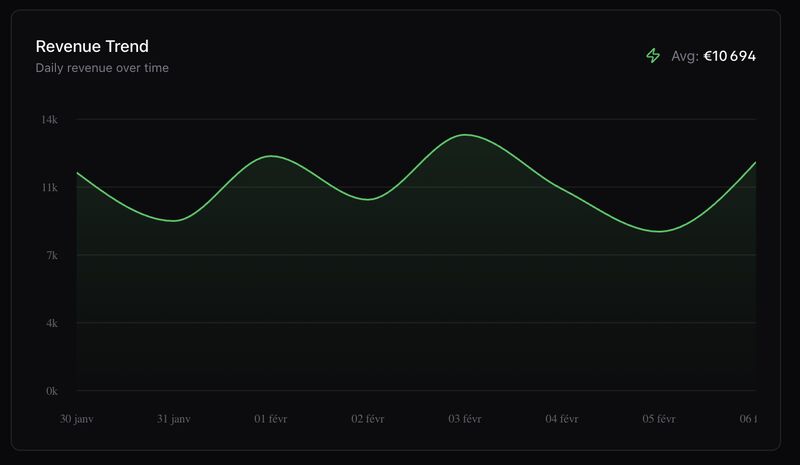
10 to 15 min a day. Zero extra posts.
The hack
At first, no one knows you. You post into the void. 3 months pass and nothing takes off. Except this desert isn't inevitable.
Without a comment routine
Crossing the desert
3 flat months. You doubt. You quit.
~300 impressions / post at 6 months
With a comment routine
Takeoff from day 1
You borrow the audience of the leaders. The algo credits you. You leave the desert.
~3,500 impressions / post at 6 months
Same creator. Same content. One single difference: commenting on others' posts every single day.
The hack
Comment.
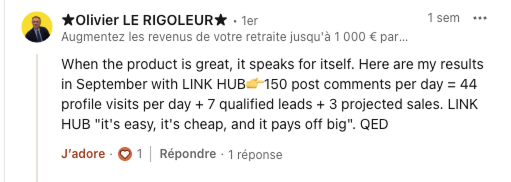
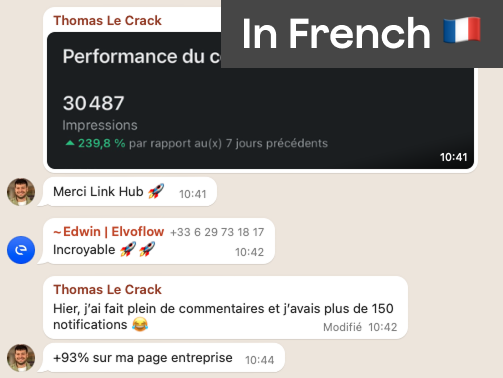
150 comments / day
+239.8% impressions
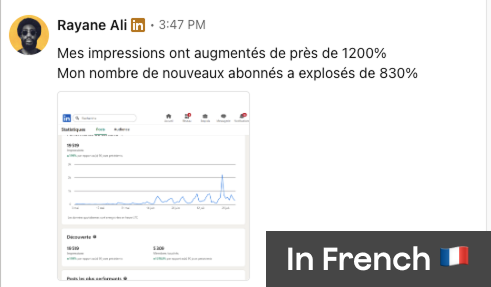
+1,200% impressions
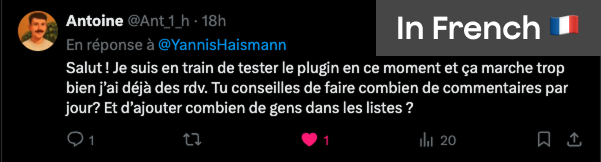
Booked meetingsPosting + commenting = your audience sees you everywhere.
The hack
The comments strategy: comment on the right person, at the right time, with the right comment.
The most important
The right person
The leaders and prospects in your niche. Not your neighbor, not your buddies. Without that, you're talking to no one.
At the right moment
Within the golden hour of their post. That's when the algo distributes the majority of the reach, and therefore the exposure that your comment will catch.
The right comment
More than 10 words, your expertise, not "great post 🔥". The goal: get them to click on your profile.
LinkHub handles it all
Comment on the right people, at the right moment, with the right comment.
The synthesis
23 points that synthesize the whole playbook. Check at least 16 boxes before publishing. Below 11, rewrite.
The idea (the base)
The packaging
The body
Before posting
If lead magnet
After publishing
An algo that predicts the virality of your posts before publishing. 25 posts generated for one displayed. On average ×7 likes in 1 month. 1M+ posts in database. Create 1 month of content in 2 clicks.
Join the waitlist →The Chrome extension that shows you who to comment, when, and with what message. 10 min a day to amplify the reach of your posts and generate more clients.
Try it free →Automatically sends your resource via DM to every person who comments on your post. In less than 10 minutes, 24/7, without you touching LinkedIn.
Discover LinkMagnet →The premium cohort program for B2B entrepreneurs. Small cohort, strict selection, integrated ecosystem. Turn LinkedIn into a client-generating machine.
Apply →